A következő címkéjű bejegyzések mutatása: KiCAD. Összes bejegyzés megjelenítése

2019. július 13., szombat

KiCAD packager

As I mentioned previously here: http://pakahuszar.blogspot.com/2019/07/chain-of-events.html
I started to write a program for KiCAD ot package the projects and overcome the problems when I share my designs.
Released a working (but probably buggy, and incomplete code) here: https://gitlab.com/suf/packagekicad. Please use the 0.2Beta tag
It is able to build a new symbol library (others come later) from the current environment with all of the used components in the current design, replace them in the schematic file. So when you move the project trough source control or other way, anybody can open it without missing components. Yes, the rescue lib can handle this, but asks questions, and the original KiCAD gitignore remove the cache used for rescue lib. Also doesn't handle the unintentional library upgrades.
The documentation is not yet exists. So I just write the usage here:

dotnet PackageKiCAD.dll <project name/directory>
Options:
-R Recursive
-cl Clear local symbol table. Keep only the packaged library on the list.

I'm using TortoiseGIT for my projects. It allows to automate the packaging. So the project gets packaged before every commit, if configured.
This is what I've done:
Opened the TortoiseGIT interface and selected Hook Scripts


Added a new script:


The "Run when working tree path is under" should point to the repository root in question. That's it.
Further development is coming.

2019. július 7., vasárnap

Chain of events

I always think, why I start more projects than I finish.
One cause is the chan of events. I start something, than something is missing is missing from it, what forms an other project, than I miss something from it - other project and the chain of events formed. Have several open things, nothing finished.
Check the current one:
I wanted to recreate my music listening environment. The first path is from vinyl.
1. Repaired the crossovers in my Mission 705 loudspeakers (replaced a few ancient Tesla caps)
2. Repaired my NAD 5120 turntable (removed the original built in cable, added a few RCA connectors, replaced the belt, adjusted the arm lift)
3. Wanted to build a new RIAA corrector. It is based on the award winning design from the '80s. Created by a local HiFi Magazine here in Hungary named HFM-I. Actually built it, but just wrote about it on my Hungarian language blog (http://it-pro-hu.blogspot.com/2019/02/hfm-i-ujragondolva.html, http://it-pro-hu.blogspot.com/2019/03/hfm-i-2.html, http://it-pro-hu.blogspot.com/2019/04/hfm-i-3.html
4. And here is the place where my "chain of events" starts. It came into my mind, that I'd like to measure what I built before put it into my system. Bought an HP 8903B Audio Analyzer (not just for this project, it was in my plans for a while already).
5. U1. I have a good set of instruments, but it wasn't a requirement to connect them to a PC until now (I was thinking, I'll do that once upon a time). For generating a graph from the 8903B it become absolutely necessary. Unfortunately didn't find a GP-IB interface what I like, so the first unplanned project born. Found an Arduino based interface, but absolutely hated the hardware, so designed a new one (http://pakahuszar.blogspot.com/2019/04/gp-ib.html, http://pakahuszar.blogspot.com/2019/04/gp-ib-2.html)
U2. Didn't like the software of the interface, neither the license, nor the implementation. Started to write a completely new code from scratch (still unfinished, it will be testable soon, if it doesn't end as unfinished project as many before).
U3. Somebody asked upon my posts, if I want to sell the GPIB interface boards I created. Started to think - why not?
If I sell it, I want to organize the hardware designs and the software correctly. Don't want to publish unfinished design, or software, so I built up a git branching model for myself to achieve this. Here surfaced my old problem again. The library handling of the KiCAD is horrible. I want to publish the hardware design without external dependency (I mean, if somebody opens the schematic, get real components instead of boxes with question marks). Tried to use KiCADs archive plugin. Unsuccessfully. Registered, but it not even started. After few days of searching, asking, got no solution.
So, the Unplanned-3 project born. Create an application (not a KiCAD plugin) what automatically manage this mess on my hardware projects (I started it in .Net Core 2.1, got some progress, but this is a topic for a further post)
Let see! This is one way how my unfinished projects are born.

2018. július 26., csütörtök

KiCAD 5.0.0

Just realized, that the KiCAD 5.0.0 arrived (four days ago).
The announcement can be read here:
http://kicad-pcb.org/blog/2018/07/KiCad-5--a-new-generation/

It has some promising new features:
- New 3D modelling (the old was almost useless)
- Spice simulation
- Change in the Github based library management
Just to list my pain points.

2017. március 25., szombat

Project 2017#1 - ESP8266 Programmer Github

As I promised here:
http://pakahuszar.blogspot.hu/2017/03/project-20171-esp8266-programmer-3.html
cleaned the GitHub repo of the ESP programmer. It also contains the ESP based development boards of mine.
The repo can be found here:
https://github.com/sufzoli/suf-electronics-ESPDEV
If you need the libraries/modules I used for this, it can be find under my KiCAD libraries/modules account here:
https://github.com/orgs/suf-KiCAD

2015. szeptember 4., péntek

KiCAD vs. GitHub

I don't know if this is documented somewhere or not. This is my findings. I see in the current KiCAD nightly builds that it is able to use module libraries from the GitHub repo, what is kind a cool. I've a long standing problem, how to share the modules I designed between my projects and machines. It would be the solution.
As somebody almost never read any manual, created a repo in my GitHub account, added my modules to it, then I went to the KiCAD and added the repo:


The result is not really what I expected.


After some reading, and trying here are my findings. The way I was thinking above, just not works.
First of all. The structure differ from that. In the KiCAD's thinking one new style of .pretty type library is "A" repo itself, and not a repo store several libraries. In addition, the KiCAD access the repo on programmatic way, so it needs some additional configuration.
So I decided to create a new organization for it on the GitHub.
Here are the steps - Kind of picture blog style. :-)

Create a new organization:


Remove the restrictions for third party application access (necessary for the KiCAD)


Add the repo for a module library:


 Adding the modules to the repo with your usual toolset


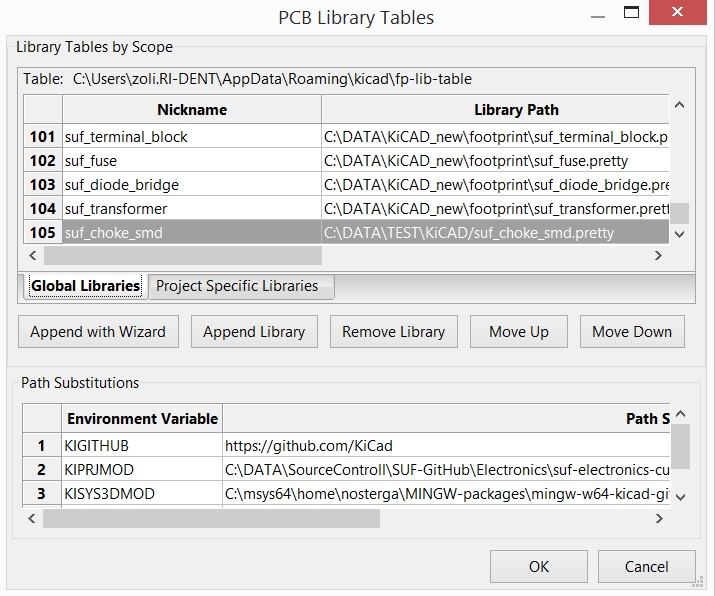
Now you can add the organization (not the repo directly) to the KiCAD:


And here is the result: