2015. szeptember 14., hétfő

Supermicro Server hacking - Failed

This is a hack, but not from software point of view. It is some hardware.
I wanted to put a 2.5" SSD into the Supermicro's 3.5" hot swap drive carrier:


Disassembled the carrier, and the problem can be seen right from the beginning:


All 3.5" drives has three holes on each side. In most cases the middle screw hole isn't used.
The carrier has no hole there. But the 2.5/3.5 conversion tray need that hole.
Hole missing, so drilled it:


The carrier also has spring inserts, what also need that hole. The spring is a very thin material. I tried to drill a hole into it:


FAIL!!!!


Ok, I still have other unused carriers, so next try. What if I mount the conversion tray before putting in the spring insert, and not drilling it at all.
Lets try:


Ooops, these screws are to long. I can't cut them while it is in the tray. The cutting will be way too hot for that plastic.
It took a while, to find out, how to secure these screws into the vise to cut them.
Finally succeeded.
At that point I assembled the whole thing perfectly. When I tried to find some screws to secure the SSD into the first thing I found the screws perfectly fits in the place of the recently cut ones. :@

Finally I tried to insert the carrier into the servers cage. Didn't fit in. I found out why:


FAIL!!! FAIL!!! FAIL!!! FAIL!!! FAIL!!! FAIL!!! FAIL!!! FAIL!!! FAIL!!! FAIL!!! FAIL!!! FAIL!!! FAIL!!! FAIL!!! FAIL!!! FAIL!!! FAIL!!! FAIL!!! FAIL!!! FAIL!!! FAIL!!! FAIL!!! FAIL!!! FAIL!!! FAIL!!! FAIL!!! FAIL!!! FAIL!!! FAIL!!! FAIL!!! FAIL!!! FAIL!!! FAIL!!! FAIL!!! FAIL!!! FAIL!!! FAIL!!! FAIL!!! FAIL!!! FAIL!!! FAIL!!! FAIL!!! 

I'm a complete idiot. I hadn't checked this in the first place.


2015. szeptember 4., péntek

KiCAD vs. GitHub

I don't know if this is documented somewhere or not. This is my findings. I see in the current KiCAD nightly builds that it is able to use module libraries from the GitHub repo, what is kind a cool. I've a long standing problem, how to share the modules I designed between my projects and machines. It would be the solution.
As somebody almost never read any manual, created a repo in my GitHub account, added my modules to it, then I went to the KiCAD and added the repo:


The result is not really what I expected.


After some reading, and trying here are my findings. The way I was thinking above, just not works.
First of all. The structure differ from that. In the KiCAD's thinking one new style of .pretty type library is "A" repo itself, and not a repo store several libraries. In addition, the KiCAD access the repo on programmatic way, so it needs some additional configuration.
So I decided to create a new organization for it on the GitHub.
Here are the steps - Kind of picture blog style. :-)

Create a new organization:


Remove the restrictions for third party application access (necessary for the KiCAD)


Add the repo for a module library:


 Adding the modules to the repo with your usual toolset


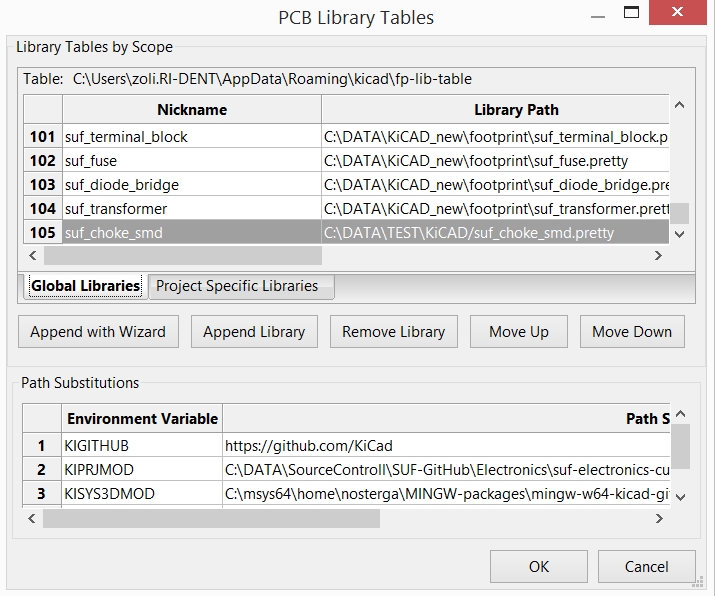
Now you can add the organization (not the repo directly) to the KiCAD:


And here is the result:


2015. szeptember 1., kedd

TI Precision Labs - Arrived

And finally...
After some fighting with the Fedex/Customs Office, it landed on my desk:


Let the learning begin...

2015. augusztus 19., szerda

Breaking News - TI Precision Labs

Here I wrote about the Texas Instruments Precision Labs, the insane price of it and my plans to replicate it.
I even started to work on it, replicated the schematics in KiCAD, created the PCBs for the OpAmp inserts, and partially designed the main board itself.
In addition I posted this project to the Hackaday.io, and it found it's way to the Hackaday blog itself:
http://hackaday.com/2015/06/10/hackaday-prize-entry-teaching-opamps/
I don't know if somebody at TI read what I wrote, but this came today in a newsletter:


So, mine is on the way to Budapest:


I payed ~$60 for it with shipping.
If you need it hurry up, while it lasts.
Notes:
First: The project is officially canceled - I've many more things to do
Second: Great thank you for Texas Instruments, for this offer!


2015. augusztus 13., csütörtök

CNC Motor Driver 13. - Front Panel Board

More than a week ago the boards finally arrived:


Then I soldered the parts into it:


I picked one of my Nuvoton development board, cut it to it's parts, and soldered the missing headers, to be able to use it as an ICE programmer/debugger:


Finally, I started to rewrite the controller's program, to the new pin configuration. During this process, I also want to little bit clean up the code.
To test the board is working, I wrote a "Hello World" for it. :-)


The board looks like working so far. The next step would be to finish the conversion/clean up the code.

2015. augusztus 5., szerda

Expandable breadboard 2. - Stickvise

When I created my expandable breadboard, I got a comment from Alex Rich who is the designer of the StickVise. He told, that I should make a "breadboard jaws" for it.
I was thinking about it, even ordered some parts (longer rod for the StickVise), and finally yesterday I made it:


And I made a video about the building. This is the first one where I'm talking, so you can see my horrible english :-)


UV Lightbox 19. - New display

As I wrote in my last entry about the Lightbox, I ordered a new display. It is arrived more than three weeks ago (I was on vacation, therefore wasn't able to write this entry).
Tested it:

It works, visible, but still dim a bit. I'll keep it until the enclosure finished. We will see, if it is good enough when it is mounted in it.