A következő címkéjű bejegyzések mutatása: repair. Összes bejegyzés megjelenítése

2023. szeptember 5., kedd

Fluke 787 "Repair"

Big thank you for DuraLeak.

"i purchased this at an estate sale.  i don't know if it works or how to turn it on.  but as it is right now i have pushed every button and nothing comes on the screen.  so because of that i am selling it for parts or repair."


Perfectly working Fluke 787 Processmeter for $143 delivered to Hungary


I need some future tests, but looks ok, for the first sight.

2023. június 28., szerda

Keithley 2700 - Repair 2.

After some serious issues with the local post, Today the new mains transformer of the 2700 landed in my hands.

So I measured a bit, then installed into the unit.


Actually it was pretty straightforward. Everything connected, assembled.
After some warmup I compared with my 7.5 digit Keithley 2010. It looks like spot on (the Digistant source not really able to keep with them).


2023. május 29., hétfő

Keithley 2700 - Repair

 I couldn't resist. Found this puppy faulty on the eBay.


It doesn't turn on. Even consume zero current from the mains.

For a quick look: the fuse is intact. Tested the AC connections from the mains transformer. Nothing come out. Ok, so either the mains transformer or the mains connector module (connector, voltage selector, mains switch) faulty.

Checked the Mains connector module. Unfortunately the available service manual is useless. So with the mains module, done some reverse engineering.

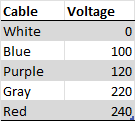
Here is the transformer's connection:


Measuring the transformer I found out, that the 100V winding is demaged.

So, I connected the 100V - 220V cables (blue and gray) to my variac, and set the voltage to 120V.


Here are the results:


For the first sight, it looks like, it has no other issue than the faulty mains transformer. Now I need to find a replacement unit, or somebody, who is able to wind a new one for me.

2022. június 15., szerda

Fluke (Philips) PM3082 Oscilloscope Repair 2.

The junk scope arrived. Yes it is a junk. At least mechanically. The front broken, few knobs also, the screen frame missing, the enclosure bent here and there.
Also it doesn't work. The low voltage power supplies looks OK, but nothing on the display, except the illumination. Even doesn't respond to the knobs, no startup beep.
Anyway. I wanted to quickly check my theory, that my original scope has probably a single failure on the processor board and no other problems.
So I gave a try. Swapped the processor boards.
Bingo.


The unit is working. At least it give sharp image, respond to the knobs/buttons. Didn't had time to check it further, but this is promising.
Here come the question:
Is it worth?
Worth to try to repair the other unit? Find missing knobs, print a new frame, glue the broken things, try to repair not just the processor board, but the other things could I face during the attempt.
I have some internal pressure to challenge myself, but ...
I don't know. We will see.

2022. május 28., szombat

Fluke (Philips) PM3082 Oscilloscope Repair 1.


I'm continuing here an almost 8 year old story:

http://pakahuszar.blogspot.com/2014/09/engineer-joke.html

http://pakahuszar.blogspot.com/2014/10/engineer-joke-continuance.html

Just in nutshell, what happened since:

I left the oscilloscope, as is for additional three years, without touching it. Unfortunately the processor board gone from the eBay, so I didn't buy it.

After this three years. I brought it to a friend, who run a repair shop. He found some issues in the high voltage PSU, repaired it. Later he started to blame the I2C bus, as it has some problems, what hold the entire control, and didn't able to pinpoint it. Once he will go back and put more effort into it.

The whole thing got forgotten. A few weeks ago, I went to him to pickup some of my donor audio equipment, and picked up the oscilloscope with it. So it is now in my new lab.

Switched it on. The errors are the same. So it not get worse in the last years, what is great from a standpoint.

With the I2C bus error in my mind. I started to go over of the schematics of the oscilloscope (just the analog board is 18 A3 pages itself - Jesus!).

Collected all of the I2C bus connected ICs from all of the boards into an Excel sheet, with the connection points need to cut for troubleshooting. One thing started to get clear during the schematics reading. Let me explain:

If I would design something with I2C control, I would put the I2C capable ICs on the bus, with different addresses and that's it. Philips did it a bit differently. There are some ICs (TTL compatible serial-to-parallel shift registers mainly), what is not I2C compatible, just connected to the I2C lines and has additional control signals (it is weird to my taste, but this is the case).
Also I realized that the front panel board has no I2C connections. It is connected to the processor via a parallel bus.

In the view of the information above, I started to reevaluate the "I2C bus has a problem" sentence.

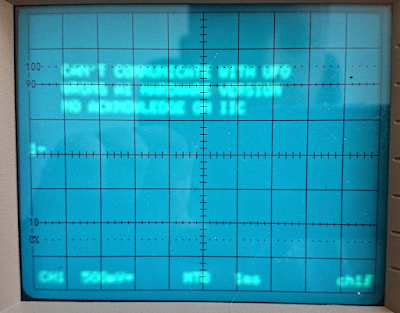
Go through the errors on the screen, one-by-one:

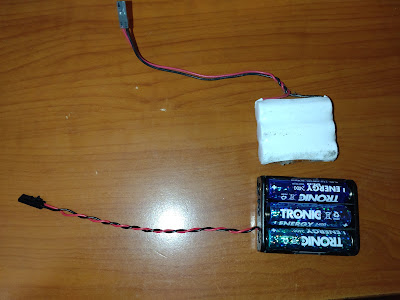
  1. "NO BATTERY BACKUP" - Irrelevant, it needs 3 AA cells what is not inserted yet
  2. "WRONG A1 HARDWARE VERSION" - It is checked with one of the shift registers mentioned above. It can be else than the I2C bus as it has different control signals
  3. "CANNOT COMMUNICATE WITH UFO" - The front panel is not I2C, so it definitely not I2C related
  4. "NO ACKNOWLEDGE ON I2C BUS" - It can be I2C related, but... If something hold the I2C bus because of the dual purpose mentioned above, can be something else also

If we assume, there is only one error causing all of the problems (likely, but not for sure), it lead us to a different direction. The A3 processor board contains a 74HCT259 providing reset for the UFO and control signals for the I2C connected non-I2C ICs. It is the first what I suspect instead of any I2C ICs.


Without logic analyzer, I wouldn't touch it further.

According the service manual, there is a raiser card exists for measuring things: 5322 218 61479

Looking on the internet, nothing come up on it. There is no other reference than this manual. Not a photo, an expired auction, an internet archive page. It virtually doesn't exists.

On the other side, it is not a highly specific thing. I redesigned it, based on the available information, according to my needs:


The oscilloscope also has a 50 pin IDC cable connection here and there. So I also designed a breakout for it:


I already ordered the boards from China. I put this repair aside until those things arrive. The oscilloscope waited for 8 years, so a few additional weeks doesn't count.

In addition I found a completely broken PM3082 on the eBay for a (few) bucks.


So I bought it. The minimum goal is to create one working oscilloscope from this two. But who knows. Maybe both can be brought back to live.
Now I wait for the things to arrive: boards from the JlcPCB, connectors from AliExpress, broken scope from Italy.


2022. január 20., csütörtök

Keithley 2001

 I bought a Keithley 2001 DMM 1,5 years ago. It has a problem: calibration lost.


Tried to extract the contents of the calibration EEPROM, unsuccessfully (finally I realized, that the type I configured on the TL866 was different, so I'll never know if the EEPROM was faulty or not), so I exchanged it to a new one. This time I also added a socket to it, so it will be easier to exchange next time.

Also burned a set of new EPROMs with the latest firmware available.


Added the Dallas NVRAM option. Later realized, that a cheaper, better option would be available:

Next time!


As you see the range down button is broken. Also time-to-time some buttons are stuck, when pressed.
Ordered a new front panel button set (https://pakahuszar.blogspot.com/2022/01/new-arrivals-2.html) and replaced it.


The multimeter looks up and running, except the calibration. I'm looking for a service to recalibrate it.


2022. január 4., kedd

HP E1300A - EPIC Fail

In the last few days I was working on my instrument control software. I wanted to test, what I achieved with an SCPI compliant device also (now I mainly use my Keithley 199 DMM for the tests).

The first SCPI compliant device I found around is a HP E1300A B-size WXI mainframe with DMM and switch cards (I've three of this).

First I wanted to clean it up, repair if it necessary.

(Read further, text continue after the first set of pictures)


Everything is clean, the dead battery pack exchanged to a battery holder. The only thing still need exchange the old Papst fan. Actually the same fan still in production but it cost insane $60 (I got the two E1300A units as a gift, and bought my first one for  $15). This one if it is new has 36dB noise level. I found a Noctua model, with the same airflow 17dB noise level. I know it is not the "industrial" one, but the unit will be lightly used in my lab, so it will be good enough. Even the fan isn't installed yet.

Just for the try switched on the unit connected a GPIB adapter and checked if I can communicate with it. Looks everything fine after assembly.

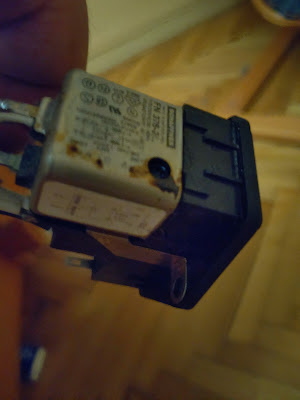
Switched off the unit and went to the bathroom. I hear some weird noise from there. Went back to my room. Thick smoke coming out from the switched off unit and stinking like hell. Pulled out the mains cable and didn't understand what happened.

Disassembled the whole unit once more:


The filter in the mains outlet blown.

At least this indicate, that probably the unit itself doesn't has further issues as result of this failure.

New outlet ordered, I'll finish the assembly when arrived.


2020. december 13., vasárnap

HP 8903B Audio Analyzer - WIP 1.

 I started to work on my instrument control software months ago (http://pakahuszar.blogspot.com/2020/09/instrument-control-1-beginning.html). When my audio analyzer related things started to work, I realized that the analyzer itself is off from the specifications, so I can't really continue the work on it as I planned. Actually I put the whole project aside for a while.

Now I feel it is the right time to continue to work on it.

The unit functionally working correctly, just some calibration (maybe recapping needed). For the calibration I would need a few raiser cards, to be able to measure things on the boards. The original raiser cards (08901-60084, 08901-60085, 08903-60018) are unobtainable. Even for the last one the schematic diagram is also missing. Fortunately the unit has no functional problems, so the processor board doesn't need troubleshooting (the last card is for this).

As the cards are not available, I ordered the matching 44 and 30 pin 3.96mm pitch connectors on the aliexpress, and designed suitable raiser cards. To make my work easier, added two things to the new cards:

  • additional 44 (30) pin 2,54mm headers to be able to measure easier on the bus.
  • additional 44 (30) pin edge connector to be able to break out the cards in 90 (instead of 180) degree (I don't know if this will be useful, we will see)

The boards at jlcpcb for manufacturing:


In addition to those, I have doubts on the EPROM long term stability. Unfortunately those 2k x 8 EPROMs doesn't exists at the regular suppliers I use. So I ordered some from the eBay.
Waiting for the things to arrive, to be able to continue.